Software is usually described by what it can begin: a project, a workflow, a conversation, a habit. We think it should also be judged by what it can finish.
A useful product should be able to answer four questions without hesitation:
- What enters the product?
- What job does it perform?
- What result belongs to the user?
- When is the product done?
The fourth question is easy to neglect. A product without a stopping point tends to turn every completed task into the beginning of another one. The export becomes a dashboard. The dashboard becomes a feed. The feed acquires notifications, streaks, rankings, recommendations, and a reason to return before the user has another real job to do.
That may increase activity. It does not necessarily increase value.
At BorealBit, we prefer a smaller contract: help with one legible job, return a useful result, and give the person's attention back.
A stopping point is part of the interface
The end of a workflow is not empty space. It tells a person what happened, what they own, and whether anything remains unresolved.
SilentProof can end with a structured incident saved privately or an evidence PDF ready to share. FrameTwin can end with both landscape and portrait versions of a take saved—or with a clear recovery state if saving was interrupted. Boreal NFC can end after a record has been validated and written to a tag. Daily Zen Maze can end when today's maze is complete.
These endings are different, but they share a pattern:
- the job is named before it begins;
- progress is understandable while it runs;
- success produces a visible result;
- failure is explicit, with recovery where the job permits;
- the interface does not invent a new obligation after completion.
Two different product loops
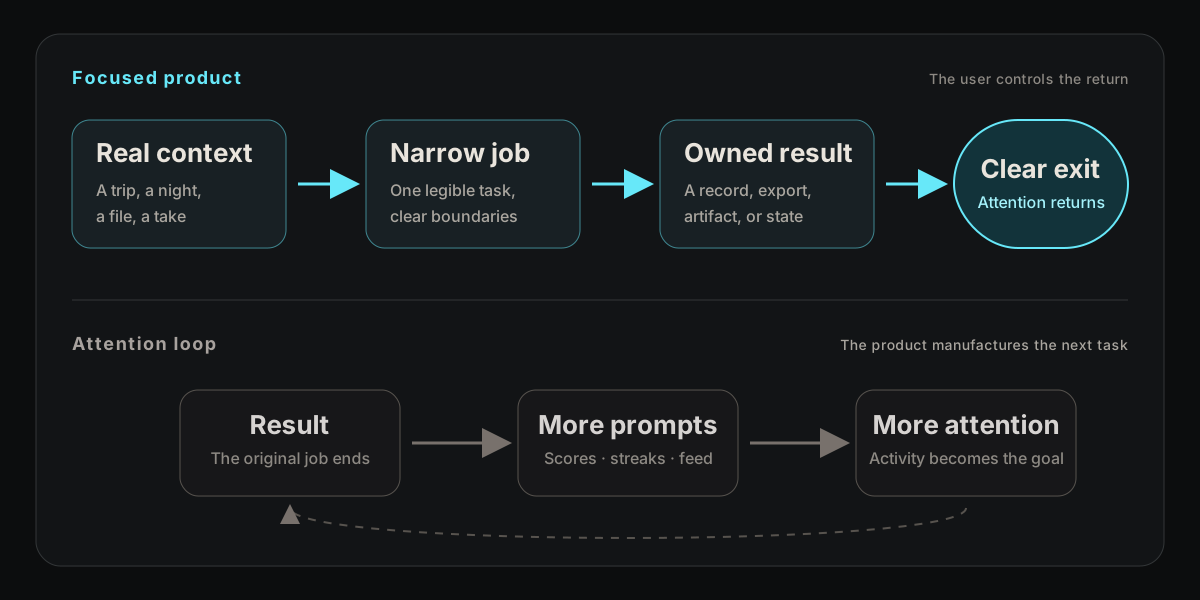
The diagram above contrasts a bounded product loop with an attention loop. The difference is not visual minimalism. It is who controls the next step.
In a bounded loop, a person brings context, completes a narrow job, receives an owned result, and leaves. The product remains available when the job returns.
In an attention loop, every result is converted into another prompt to remain: check a score, protect a streak, respond to a recommendation, inspect a ranking, or discover one more feature. The product begins to optimize for its own continuity.
We do not believe every recurring product is manipulative. A sleep diary, mileage log, or daily puzzle is useful precisely because the underlying activity recurs. The important distinction is whether the return is anchored to a real event in the person's life or to pressure generated by the software.
Narrow does not mean incomplete
Focused software is sometimes treated as a temporary stage on the way to a platform. We see it differently. A narrow job can demand considerable depth.
A reliable camera needs permission checks, storage checks, explicit save results, and recovery from interruption. A private health journal needs understandable fields, careful limits, durable local storage, and exports that another person can read. An NFC editor needs to expose record details, validate changes, respect hardware constraints, and explain why a write cannot proceed.
The scope can be narrow while the implementation is serious.
| Product area | The narrow job | A useful result | Where the product stops |
|---|---|---|---|
| Records and care | Preserve context that memory may lose | A reviewable history or export | Before diagnosis, legal judgment, or treatment advice |
| Creative utilities | Help create or transform a specific artifact | A file, take, document, tag, or MIDI draft | Before replacing the person's broader creative workflow |
| Quiet play | Offer a short, self-contained activity | A completed puzzle or calm session | Before rankings, energy timers, or social pressure |
This boundary is not an apology for missing features. It is a statement about the product's authority.
SleepLedger records how sleep felt; it does not claim to measure sleep stages or diagnose a disorder. SignalProof generates repeatable digital signals; it is not a certified calibrator. MotifPilot creates editable MIDI starters; it is not a full DAW or an automatic claim to a finished song.
Saying what a product does not do is part of making what it does trustworthy.
The result should survive the session
A stopping point matters more when the result can leave the interface.
Several BorealBit products produce ordinary artifacts: PDF, CSV, Markdown, MIDI, video, or an NFC record written to a physical tag. Others preserve local state that a person can return to without creating an account. The form varies, but the principle is the same: the value should not exist only as a temporary view inside our application.
An export is not a secondary checkbox added after the core experience. It is evidence that the product understands who owns the work.
This also changes how we think about local-first design. Keeping a record on the device matters when it makes the product's boundary more legible:
- the record stays close to the person it describes;
- sharing is an intentional action;
- deletion has a comprehensible meaning;
- the product does not need a permanent account relationship to justify itself.
There are cases where synchronization, collaboration, or cloud processing provides a real benefit. Those capabilities should be introduced because the job requires them, with the new data boundary stated clearly—not because every product is expected to become a service.
Engagement is not the same as usefulness
Most product teams need some measure of whether software is helping. The mistake is to let the easiest measures become the goal.
Sessions, retention, notification opens, and time spent can reveal behavior. They cannot, by themselves, tell us whether the product respected the person using it. A mileage app that reduces the time required to review a month may create fewer sessions. A camera that saves both formats correctly on the first attempt may prevent repeated work. A daily puzzle that ends after a few quiet minutes may be working exactly as intended.
For focused software, completion can be a stronger signal than consumption.
That leads us toward different questions:
- Did the person reach the intended result?
- Was the result clear and recoverable?
- Could they take it into the next part of their work?
- Did the product ask for more data or attention than the job required?
- Did it communicate uncertainty and limitations honestly?
These questions are harder to compress into a single growth chart. They are closer to the standard we want to hold.
When should a focused product grow?
"Know when to stop" does not mean never improve. A product should change as we learn where the job is incomplete, fragile, or unnecessarily difficult.
We use three tests before expanding a product:
- Does the change complete the same job more reliably? Recovery, validation, accessibility, and clearer exports usually pass this test.
- Does it preserve the product's boundary? A useful extension should not quietly turn a record into a diagnosis or a utility into an account-dependent platform.
- Can the person still understand when they are done? More capability should not erase the end state.
Features that pass these tests can deepen a focused product. Features that primarily create another surface to visit deserve more skepticism.
This is also why we do not treat a portfolio of narrow products as a failure to consolidate. Noise documentation, sleep reflection, MIDI drafting, NFC editing, dual-format video, PDF preparation, and quiet puzzles are genuinely different jobs. Forcing them into one broad platform would make the company diagram simpler while making each product harder to understand.
A quiet standard
Small software is not software that lacks ambition. It can be ambitious about reliability, restraint, privacy, accessibility, recovery, and the quality of a result.
Our products span personal records, creative work, practical utilities, and quiet play. They do not share one feature set. They share a working standard:
- choose a job narrow enough to describe plainly;
- make inputs, outputs, and limitations visible;
- keep authority proportional to evidence;
- leave the person with something they understand and control;
- stop when the job is complete.
The last point may be the least visible part of the design. It is also one of the most respectful.
Good software should be ready when it is needed. It should be dependable while it works. And when the work is done, it should be comfortable becoming quiet again.