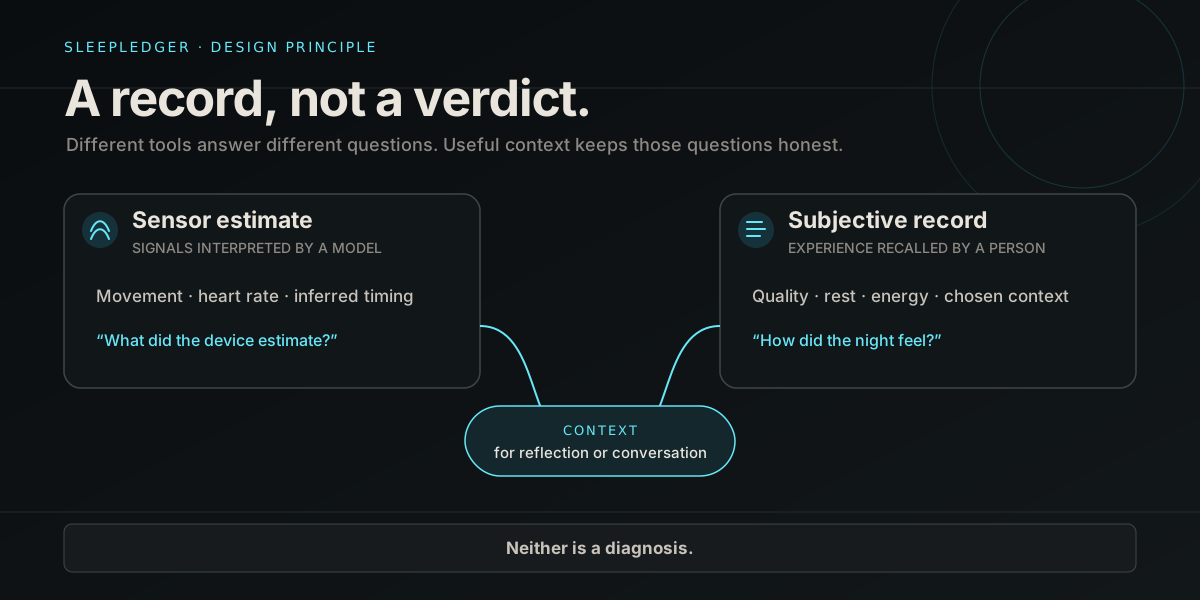
A number can feel more certain than it is. Each morning, a sleep tracker may present a score with the visual confidence of a verdict: good, fair, poor. The number can be useful, but it can also compress several different questions into one answer.
How long did a device estimate that you slept? How did the night feel? Do you feel restored? Is it harder to function today? Is one difficult night an exception, or part of a pattern worth discussing?
No single score answers all of these questions. They belong to different layers of sleep: measured signals, estimates made from those signals, remembered experience, and daytime effect. We designed SleepLedger for one deliberately narrow layer. It is a short subjective record of how sleep felt and how the next day began.
That makes it a memory aid, not an authority. Its job is to help a person notice, remember, and communicate. It is not there to decide whether a night passed or failed.
Different tools answer different questions
A sensor can observe movement, heart rate, breathing-related signals, or changes in light and temperature. An algorithm may use those signals to estimate sleep and wake periods or infer sleep stages. The output is not the signal itself; it is an interpretation based on a model, a device, and the conditions in which it was used.
A subjective diary does something else. It records what a person can report: whether sleep felt restorative, how rested they feel, their energy on waking, and any context they choose to remember. That information is also incomplete. Recall is imperfect, and a feeling is not a measurement of brain activity. But it describes a part of sleep that a wrist sensor cannot directly experience.
The point is not to declare one layer superior. It is to keep the questions honest.
The American Academy of Sleep Medicine's position statement on consumer sleep technology makes a similar boundary important: consumer-generated sleep data may contribute to a patient-clinician conversation, but it should not replace validated diagnostic methods or a clinical evaluation. A device estimate and a subjective record can both provide context. Neither is a diagnosis.
A record should not become a referee
Sleep is already easy to turn into a performance project. A streak asks for one more perfect day. A red score can make an ordinary variation feel like a warning. A prescribed target can make someone work at sleeping—a task that becomes harder when effort turns into vigilance.
There is a name sometimes used for an excessive pursuit of ideal tracker numbers: orthosomnia. The original 2017 Journal of Clinical Sleep Medicine paper described only three clinical cases. That is useful as a warning, not proof that sleep tracking causes anxiety or insomnia in everyone. Consumer sleep tools can be helpful, and many people use them without distress.
Our conclusion is therefore a product judgment, not a universal medical claim. If a feature can provide the benefit of remembering a pattern without turning that pattern into a grade, we prefer the quieter form.
SleepLedger has no nightly score, no leaderboard, and no streak to protect. A missed morning is missing data, not broken progress. A difficult night remains an observation, not a failure state. The interface can show change across days, but it does not rank the person who recorded it.
One feature needs a clear distinction: SleepLedger includes an optional weekly ISI reflection. Unlike an automatic nightly score, it is a user-chosen questionnaire at a slower cadence. Its result is presented as screening context, not a diagnosis, and it does not turn each recorded night into a grade. A person can skip it and continue using the core diary.
The design choices behind the diary
Every additional field can create more detail, but it also creates another reason not to make an entry. We chose a small morning check-in because consistency matters more to this product than exhaustive capture. “Ten seconds” is a design target, not a clinically established optimum.
The resulting choices are intentionally limited:
| Design choice | What it is for | What it does not claim |
|---|---|---|
| A short morning check-in | Capture quality, rest, energy, and optional context while the night is recent | A complete clinical sleep history |
| No automatic score | Keep entries descriptive rather than evaluative | That all sleep scores are harmful or useless |
| No streak | Make returning easy after a missed day | That regular records never matter |
| Optional weekly ISI reflection | Offer a user-chosen screening context separate from nightly entries | A diagnosis or replacement for clinical evaluation |
| Simple pattern views | Help a person compare days and remember changes | That one recorded factor caused another |
| Local-first storage | Keep routine records on the device by default | Perfect security, medical compliance, or clinical efficacy |
| User-initiated PDF or CSV export | Make a chosen period easier to review or share | A diagnosis or a clinician-validated report |
The distinction around patterns matters. If caffeine, travel, pain, exercise, or a late meal appears beside a difficult night, the diary may help someone remember that co-occurrence. It cannot determine causation. The product does not know every relevant factor, cannot control for confounders, and should not turn a small personal record into a treatment recommendation.
Why the export uses a two-week window
The National Heart, Lung, and Blood Institute notes that keeping a sleep diary for one to two weeks before a medical visit may help a doctor understand a sleep problem and the activities that may affect it. Its public sleep diary includes sleep quantity and quality, medicines, alcohol, caffeine, and daytime sleepiness, then suggests bringing the record to a doctor.
This supports a modest idea: a short run of daily observations can be more useful than trying to reconstruct several weeks from memory during one conversation. It does not mean that two weeks of entries are sufficient to diagnose insomnia or any other condition.
There is also a formal research precedent for subjective records. The Consensus Sleep Diary was developed by sleep experts and informed by patient feedback to standardize prospective sleep self-monitoring. It contains defined questions and calculations designed for research and clinical contexts.
SleepLedger is not the Consensus Sleep Diary. It uses fewer inputs, does not reproduce that instrument, and has not been validated as an equivalent. Its two-week export is a readable personal record. A clinician may find the context useful, ask for different information, or use a validated instrument instead.
Local-first is a boundary, not a badge
Sleep records can reveal routines, symptoms, medication context, travel, stress, and the shape of a person's day. We do not think routine access to that history should be the price of keeping it.
SleepLedger therefore keeps records on the device by default. The core diary can remember last night without first sending it to a BorealBit server. Sharing begins when the user chooses an export and uses the system share flow.
This architecture reduces routine transmission to a company server, but “local-first” is not a magical guarantee. Device access, operating-system backups, exported files, and the destination a person chooses all have their own privacy and security properties. The honest promise is narrower: BorealBit does not need a cloud copy of the diary for the core record-and-review loop to work.
Where the product stops
SleepLedger does not measure sleep through sensors. It does not infer sleep stages, detect sleep apnea, diagnose insomnia, recommend medication, or prescribe a sleep schedule. It is not intended or marketed to diagnose or treat a condition. Its core diary is not a validated clinical assessment, and the app is not a cognitive behavioral therapy program.
That final distinction is important. For adults with chronic insomnia, the American College of Physicians guideline recommends cognitive behavioral therapy for insomnia, or CBT-I, as the initial treatment. The AASM behavioral treatment guideline strongly recommends multicomponent CBT-I and cautions against treating sleep hygiene education alone as an effective stand-alone therapy.
A compact diary should not borrow the authority of those treatments. It may help someone arrive at a conversation with a clearer memory. It cannot conduct the clinical history, consider other sleep or health conditions, tailor a treatment, or monitor safety.
If difficulty sleeping persists and affects daily activities, the appropriate next step is a healthcare professional, not a more persuasive chart. Symptoms such as loud frequent snoring, waking while gasping or short of breath, or serious daytime sleepiness also deserve professional attention. A record can support that handoff; it should never be designed to delay it.
Quiet software can still be useful
Removing a score does not remove information. It changes the relationship between the information and the person reading it.
We want SleepLedger to help answer a few restrained questions: How did recent nights feel? Is there a pattern I want to remember? What context would be hard to reconstruct later? Do I want to share this record with someone I trust?
Those questions leave room for uncertainty. They also leave authority in the right place—with the person describing their experience and, when care is needed, with the qualified professional helping them understand it.
That is the standard we want for a quiet sleep diary: a record when memory needs help, context when a conversation needs it, and no verdict pretending to be more certain than the evidence allows.